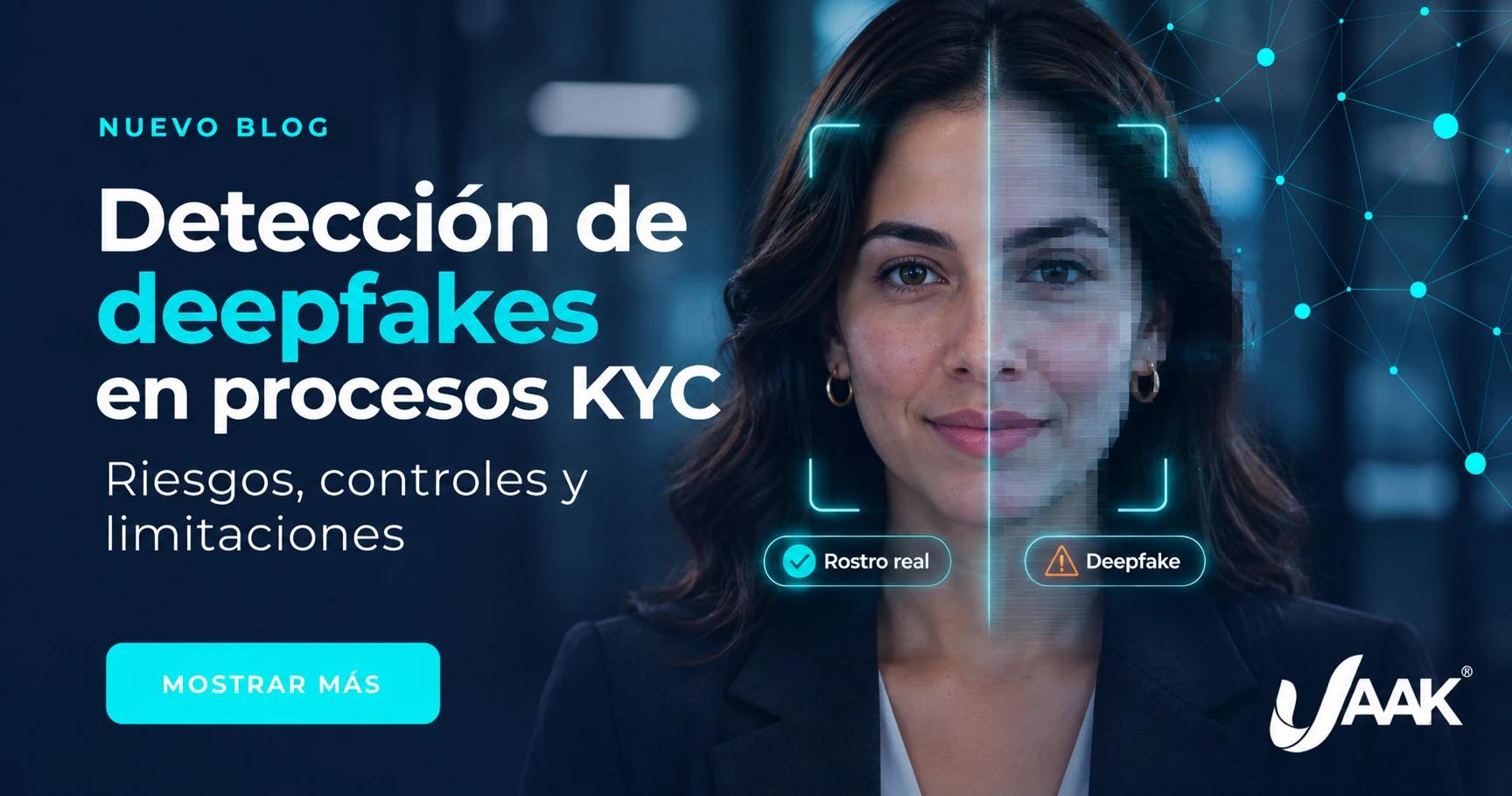
A video call, a selfie or a face that matches an ID is no longer sufficient, on its own, to prove who is carrying out a digital transaction.
Generative artificial intelligence makes it possible to produce and modify images, videos and voices that can be used to represent real people. When these techniques are used to try to deceive identification systems, they pose a risk to banks, fintechs, SOFOMES and any organization that onboards customers remotely.
In this context, deepfake detection in KYC processes becomes an important component of fraud prevention, but it should not be mistaken for a single or infallible solution.
What exactly is a deepfake? How can it be used to impersonate identities? Can biometric liveness detection detect it? And what controls should a company consider before purchasing anti-fraud technology?
In this guide we explain the risks, protective measures and limitations that organizations using digital identity verification should understand.
What is a deepfake and how does it work?
A deepfake is digital content generated or manipulated using artificial intelligence techniques to artificially represent a person's appearance, voice or performance.
It can be produced from images, videos or recordings available of a real person, or it can represent a fictitious identity.
The best-known formats include:
- Image deepfakes: photographs digitally generated or modified to depict a face or alter its appearance.
- Video deepfakes: sequences that can represent movements, expressions or appearances that do not correspond to a genuine recording.
- Voice cloning: synthetic audio that reproduces certain characteristics of a person's voice.
- Real-time facial manipulation: alteration of the appearance of a face during a video stream or capture.
These technologies also have legitimate applications in entertainment, accessibility and audiovisual production.
The risk arises when they are used without authorization to deceive people or systems and impersonate another identity.
Why do deepfakes pose a risk to KYC processes?
KYC (Know Your Customer) is a set of procedures used to know and identify customers, verify relevant information and manage risks in line with an organization's needs and obligations.
In digital processes, identity can be assessed through documents, registry checks, biometrics and additional security mechanisms.
An attacker may try to exploit weaknesses in these processes to present manipulated information or content.
For example, an organization may receive a facial image that appears to match the photograph on an official ID.
But that similarity does not automatically prove that a genuine person is present in front of the camera.
This distinction is essential:
- Facial comparison assesses the correspondence between faces.
- Liveness detection assesses signals of a genuine presentation.
- Other controls must protect the authenticity of the source and the integrity of the capture.
When these functions are confused, a company may place too much trust in a single verification. To learn more about these differences, read our article on facial recognition and liveness detection.
How can deepfakes be used to attempt to compromise a KYC process?
It is important to distinguish between several attack mechanisms, because not all of them can be mitigated with the same technology.
1. Photographs and videos presented in front of a camera
An attacker can hold up a photograph or play a video in front of the device used to verify an identity.
The content may be genuine, manipulated or artificially generated.
This is an example of a presentation attack, because the artifact is physically placed in front of the sensor.
Presentation attack detection (PAD) mechanisms are designed to assess certain attempts of this type.
2. Real-time facial deepfakes
A person may try to digitally alter their appearance during a remote interaction in order to represent another person's face.
In these scenarios, the system must assess not only facial similarity but also the characteristics of the capture and possible signs of manipulation.
Resistance to these attacks depends on the controls implemented and the tests performed.
3. Digital injection attacks
Injection attacks introduce altered digital content directly into the information flow received by a system.
Unlike a photograph presented to the camera, here the manipulation attempt can occur between the capture device and the component that processes or compares the information.
For example, a synthetic video sequence may try to replace the signal that an application expects to receive from a camera.
This poses a particular challenge: the content may appear to be a valid capture without having been obtained from a genuine sensor during the session.
The NIST SP 800-63A-4 guide warns that liveness detection and biometric comparison are not enough, on their own, to prevent all injection attacks.
4. Combination of forged documents and manipulated faces
An impersonation attempt can also combine different techniques.
For example, an altered ID may be accompanied by a manipulated facial image in an attempt to create an apparent match between the document and the person.
In this scenario, verifying only the face or only the document would leave part of the risk unassessed.
That is why it is important to put complementary controls in place.
Can a selfie detect a deepfake?
No necesariamente.
A selfie is an image, but by itself it does not constitute verification of genuine presence or confirmation of identity.
A system that only compares the selfie with a reference photograph may struggle with certain manipulated content if it does not incorporate additional security mechanisms.
A more complete assessment may consider:
- The authenticity and consistency of the document.
- Facial comparison against a reference.
- Presentation attack detection.
- The integrity of the capture source.
- Signals of image or video manipulation.
- The registry checks available.
- The results and exceptions of the process.
Each component answers a different question.
How does liveness detection, or liveness, help prevent deepfakes?
Biometric liveness detection analyzes characteristics of a capture to assess whether it corresponds to a genuine presentation.
In facial biometrics, it can help detect certain impersonation attempts using photographs, replayed videos or masks, depending on the technology and the scope of your evaluation.
Existen dos enfoques principales.
Liveness activo
Requests specific actions during capture, such as turning the head or following an instruction.
Liveness pasivo
It analyzes signals available during capture without requiring the movement challenges characteristic of the active modality.
The difference between the two approaches lies mainly in the interaction required and the mechanisms used.
It should not be assumed that one is universally more secure than the other.
To assess its resistance, it is necessary to review the attacks used during testing, the error rates and the implementation conditions.
Can passive liveness detect deepfakes?
It can help detect certain presentation attack attempts, depending on the capabilities demonstrated by the solution.
However, not all passive liveness implementations detect all types of deepfake.
Protection against AI-generated media and injection attacks requires additional evidence on the scope of testing and the controls available.
Therefore, when evaluating a provider, it is advisable to request specific results for the threats the company faces.
What controls should a KYC process incorporate against deepfakes?
A digital identity strategy should be designed using complementary controls.
First layer: document verification
It allows capturing information from an identification document and performing the available document verifications.
OCR helps extract data, while authenticity and validity checks serve different functions.
Second layer: facial biometric comparison
The 1:1 comparison assesses whether the captured face matches the reference image.
Its result must be interpreted considering the capture conditions, the configured threshold and the reliability of the reference.
Third layer: presentation attack detection
PAD (presentation attack detection) mechanisms can help identify certain attempts made using photographs, videos, screens or masks.
Fourth layer: controls against injection and digital manipulation
Where applicable, the architecture should incorporate mechanisms to increase confidence in the origin of the capture, protect communication and detect signs of manipulation.
These controls may include integrity validations, media analysis, device trust mechanisms and capture controls.
Its availability must be verified for each provider.
Fifth layer: additional queries and checks
Queries to INE, CURP, RENAPO and other authorized sources can complement information verification.
A favorable registry query does not automatically prove that the person who provided the data is its owner.
Sixth layer: traceability and incident review
Results, errors and inconsistencies must be managed through operating rules.
A company needs to distinguish between a fraud attempt, a low-quality capture and an inconclusive verification.
It should also define when to request a new capture, additional information or a manual review.
Protection does not depend solely on detecting a fake image, but on properly assessing the entire identity process.
How do you know whether a deepfake detection technology is reliable?
Before contracting, it is advisable to review the available technical evidence.
Evaluaciones independientes
Specialized laboratories and standards make it possible to assess aspects of biometric performance under defined conditions.
For example, ISO/IEC 30107-3 sets testing and reporting methods for presentation attack detection.
It is important to distinguish these assessments from other specialized tests of digital manipulation or media injection.
Biometric accuracy
Accuracy can refer to different tasks: face comparison, recognition, attack classification or document processing.
Not all metrics mean the same thing.
An accuracy figure alone does not indicate which types of deepfake were detected or how many fraudulent attempts succeeded in getting past the system.
To interpret it, you need to know the methodology, the evaluation data and the disaggregated results.
False positives and false negatives
A false positive in an anti-fraud process can cause a legitimate person to be incorrectly flagged.
A false negative may represent an attack that the system did not detect.
Both errors have operational consequences and must be evaluated according to the actual conditions of use.
Updating against new threats
Content generation and manipulation technologies are evolving.
That is why it is important to review how controls are updated, which versions are deployed and how their behavior is assessed against new types of attacks.
Deepfakes in Mexico: which sectors face these risks?
Bancos e instituciones financieras
Remote onboarding, information updates and certain account recovery procedures can involve impersonation risks.
Institutions must consider controls appropriate to their operations and to the regulations that apply to them.
Fintechs and digital lending companies
Credit platforms may face sign-up attempts using other people's identities or manipulated evidence.
Biometric verification can provide signals to the onboarding process, without replacing credit assessment.
SOFOMES
Digital origination and onboarding processes can benefit from document and biometric verifications that allow the applicant's identity to be assessed.
The entity must define the rules for interpreting results and addressing discrepancies.
Inmobiliarias
In remote identification processes for clients and transaction participants, manipulated content may pose an additional risk.
Digital identity verification can complement documentary controls, but it does not replace applicable legal formalities or obligations.
Professional and notary services
Deepfakes can increase the complexity of remote identity verification.
Technology tools can support certain procedures without replacing the responsibilities and functions that legally correspond to professionals or notaries public.
Plataformas digitales
Companies that manage user onboarding or sensitive actions may consider controls against identity impersonation, proportionate to risk and with adequate protection of personal data.
What does JAAK do to strengthen identity fraud prevention?
At JAAK, we develop digital identity technology to help companies incorporate document and biometric verification into their processes.
Our KYC solution includes several capabilities that can work together. Learn about the JAAK identity verification solutions.
Passive Liveness detection
Passive liveness technology analyzes the facial capture without requiring the movement challenges typical of an active test.
JAAK has an iBeta Level 1 evaluation of its passive liveness detection; its scope should be interpreted in line with the version, artifacts and conditions evaluated.
1:1 biometric comparison
It allows assessing the match between the captured face and a reference photograph.
JAAK reports a biometric accuracy of 99.6%. This indicator describes a biometric performance measurement that must be interpreted according to its methodology and evaluation conditions.
It should not be confused with a deepfake detection rate, a fraud prevention rate or an identity guarantee.
Document validation and official lookups
JAAK's solutions include document OCR capabilities and information lookups, which can complement the biometric process depending on the contracted service.
Evidence and traceability
JAAK lets you record verification results and events to support process tracking and the integration of the digital file.
The available evidence depends on the capabilities and conditions of the contracted solution.
Integration by operation
Companies can evaluate the use of the JAAK web platform or API and SDK integration projects, depending on the contracted modality and scope.
The goal is to incorporate appropriate controls into the process, considering both security requirements and the user experience.
Frequently asked questions about deepfakes and KYC
What is an identity deepfake?
It is an image, video or audio generated or manipulated with AI that can be used to artificially represent a person.
Can a deepfake be detected through facial recognition?
Facial comparison alone does not guarantee detection of manipulated content. Additional controls are needed depending on the attack mechanism.
Does a liveness check prevent all deepfakes?
No. It can mitigate certain attacks within its evaluated scope, but it does not replace all the controls needed against injection and digital manipulation.
What is the difference between spoofing and deepfakes?
Spoofing is a broad term for impersonation attempts. A deepfake is a type of synthetic or manipulated content that can be used in a spoofing attack.
What is a biometric injection attack?
It is an attempt to introduce biometric information or manipulated media into a system's digital flow, instead of obtaining them genuinely through the expected capture process.
Is passive liveness sufficient for a KYC process?
It depends on the risk and on the other controls implemented. A liveness test does not automatically replace document verification, database checks or the other customer due diligence activities.
What does a biometric accuracy of 99.6% mean?
It is a performance indicator that must be interpreted according to the task and methodology used. Without that information, it cannot be extrapolated to deepfake detection or to the performance of an entire KYC process.
Which standards help assess biometric security?
ISO/IEC 30107-3 provides methods for evaluating presentation attack detection. The NIST SP 800-63 guidelines also offer references on identity verification and threats in remote processes.
Is it mandatory to use a deepfake detector in Mexico?
There is no universal obligation for all companies to use a specific deepfake detection product. Controls should be assessed according to the sector, the risk and the applicable provisions.
How do you protect digital onboarding against fake identities?
Through a process that combines appropriate checks, protection of the capture source, rules for handling anomalies and sufficient evidence to support the company's decisions.
When an image can be forged, trust must be verified
Artificial intelligence is changing the way images, videos and voices are generated.
In this context, digital trust cannot rely solely on a face resembling the one on an identification document or on a video call appearing convincing.
Companies need to understand what risks they face, which controls can mitigate them and what limitations each technology has.
Deepfake detection is one part of that challenge. Document verification, biometrics, liveness detection and traceability can provide complementary controls within a digital identity strategy.
Because a convincing image is not the same as a verified identity.
At JAAK, we help organizations incorporate biometric technology and identity verification into their digital processes.
Is your company prepared to assess impersonation risks in its onboarding?
Learn about the JAAK identity verification solutions y request a demo to review which capabilities fit your operation.